


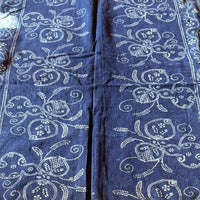
A striking example of handwoven indigo cloth whose dotted vinework seems to shimmer as it moves across the surface.
This antique textile was created using dabu, a mud-resist technique long practiced in Rajasthan, India—especially in the villages around Bagru and Sanganer. The signature is unmistakable: delicate dot-based outlines that form curling vines and lotus-like petals, a vocabulary characteristic of mid-century Rajasthani work. Woven in two loom-width panels (each about 18–20" wide), the cloth uses a handwoven cotton base that carries indigo beautifully, showing the slightly chalky surface tone and soft interior fading that natural dyes develop over time.
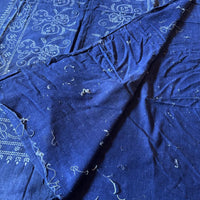
Several construction clues reinforce its Rajasthani origin: the soft rolled selvages typical of rural Indian pit-loom weaving, the distinctive dotted motifs rather than continuous stencil lines, and the weave structure visible on the reverse. From the 1930s through the 1960s, cloth like this was exported widely—including to Japan—where it was valued for household use as durable yardage for futon covers, noren, and interior textiles.
Today, this cloth offers generous possibilities. Use it whole as a wall hanging or table runner, or incorporate it into clothing, patchwork, or boro-inspired textile work. Its fine patterning rewards both collectors and creatives looking for antique indigo with history, movement, and soul.
Age: Estimated 1930s–1950s, based on handwoven construction, panel width, indigo tone, dotted resist patterning, and selvage characteristics typical of Rajasthani dabu textiles exported during this period.
Dimensions: 40.5" × 94.5" (103 × 240 cm)
Panel count: 2 panels wide (standard Rajasthani pit-loom width ~18–20" each)
Made in Rajasthan, India